History
Mont-Saint-Michel History: From a Bishop's Dream to an Island Again
Mont-Saint-Michel began, according to legend, in 708, when the archangel Michael appeared three times in a dream to Aubert, bishop of Avranches, and asked him to build a sanctuary on a granite island then called Mont Tombe. Benedictine monks settled on the rock in 966, the Romanesque abbey church was begun in 1023 and the Gothic monastery known as the Merveille from 1204. During the Hundred Years’ War the abbey became a fortress that held out against the English, and after the French Revolution it was a prison until 1863.
The rest is the story of a monument rescued and then of an island restored. The abbey was classified as a Historic Monument in 1874; a road causeway built in 1879 tied the rock to the mainland, and a dam and a bridge, part of works completed in 2015, made it an island again. UNESCO added Mont-Saint-Michel and its Bay to the World Heritage List in 1979. Today the commune has a couple of dozen residents (INSEE counted 23 in 2023) and about a dozen monks and nuns live in the abbey.
The short answer
- Founded: by legend in 708, after Bishop Aubert’s dream; Benedictine monks from 966.
- Built: the abbey church from 1023, the Gothic Merveille from 1204.
- Besieged: by the English from 1423; the Mount came out victorious in 1434.
- A prison: from the Revolution until 1863; the tourist office counts 14,000 prisoners in that time.
- Rescued: classified as a Historic Monument in 1874; the spire and its gilded statue of Saint Michael date from 1897.
- An island again: works on the dam and the bridge ran from 2006 to 2015.
- Today: a commune of 23 residents (INSEE, 2023), a monastic community of about a dozen, and between 2.5 and three million visitors a year depending on the source.
Mont Tombe and Aubert’s dream
Before it belonged to Saint Michael, the granite rock was known as Mont Tombe. The Centre des monuments nationaux, the state body that runs the abbey, presents Aubert’s dream as legend rather than record. The tourist office names Aubert as bishop of Avranches, the town that still looks across the bay at the Mont from the Normandy shore.
The choice of patron was not random. The first oratory echoed the earliest sanctuary built for the archangel, on Mount Gargano in Puglia, in southern Italy. In medieval belief Saint Michael was the leader of the heavenly host, the one who defeats the dragon in the Book of Revelation and weighs souls at the Last Judgement. UNESCO notes that sanctuaries to Saint Michael were traditionally placed in places that are hard to reach, and a granite rock ringed by quicksand and some of the strongest tides in Europe fitted that tradition well.
Nothing visible on the Mont goes back to Aubert’s time. The oldest part of the present abbey is the small pre-Romanesque church of Notre-Dame-sous-Terre, which UNESCO dates to the tenth century.
The Benedictines arrive
In 966 Duke Richard I of Normandy installed Benedictine monks on the Mont, living under the rule of Saint Benedict.
The village began at the same time. As the monks built their first church, a settlement grew up below the Mount to receive the first pilgrims. That pairing, an abbey above and a village of inns, shops and houses below, has defined the Mont ever since, and it is one of the reasons UNESCO gives for its listing: the co-existence of the abbey and its fortified village within the confined limits of a small island.
Building on a pyramid of rock
The engineering problem was obvious from the start. The summit of the rock is a point, not a plateau, and a great church needs a flat floor. The eleventh-century builders solved it by building four crypts around the tip of the rock and setting a large abbey church on top of them. By tradition, work on the Romanesque church began in 1023.
The results are still standing. The abbey church rises to 80 m at the top of the rock, on a platform 80 m long. Under it, the Romanesque Saint-Martin crypt, built shortly after the year 1000 to carry the transept, has a vault spanning nine metres. The monks’ covered gallery has a vault built after 1103 that UNESCO describes as one of the earliest examples of ribbed vaulting, the technique that would become the signature of Gothic architecture.
Once the church was going up, the Mont became, in the abbey’s words, an essential place of pilgrimage for the whole Christian West.
The Merveille: a Gothic monastery on the north face
The next leap came after a change of rulers. In the thirteenth century a donation from Philippe Auguste, King of France, following his conquest of Normandy, paid for a new block of monastic buildings on the steep north side of the rock. UNESCO dates them from 1204 and notes that they earned the name Merveille, the Marvel, for the elegance of their design.
The Merveille is formed of two three-storey buildings, crowned by the cloister and the monks’ refectory. The cloister sits on top of the whole stack, open to the sky, with a colonnade of 137 small columns in staggered rows; an opening on its west side looks straight out over the bay. Beneath it are the great Gothic halls where the monks received guests and copied manuscripts.
Pilgrims, kings and manuscripts
The medieval Mont was more than a building site. The abbey produced, kept and studied a large number of manuscripts and became a major centre of learning. Two hundred of its medieval manuscripts survive and are now kept in Avranches.
Pilgrims came from every level of society. The abbey’s own history lists kings of France and England among them, including Henry II Plantagenet, Saint Louis and Louis XI, as well as Anne of Brittany and Francis I. The crossing was part of the pilgrimage, and part of the danger: scenes 16 and 17 of the eleventh-century Bayeux Tapestry show knights struggling in quicksand in front of Mont-Saint-Michel.
The Hundred Years’ War: how the abbey became a fortress
The Mont’s military history is the main reason people describe it as a castle. In the Middle Ages the abbey was also a fortress of the duchy of Normandy, and the Hundred Years’ War (1337–1453) turned it into a strongpoint. The tourist office describes a series of military works that let the Mount withstand a siege of almost 30 years.
The abbey’s own account is more precise about the decisive phase: the Mount underwent an English siege from 1423 and came out victorious in 1434, after which it became a symbol of victory for the kingdom of France. Its defences were the ramparts and the tides together. The English were never far away: the islet of Tombelaine, about 3 km from the Mont, became an English stronghold and still holds ruins from that period.
The war also brought disaster inside the walls. In 1421, at the worst of the siege, the Romanesque choir of the abbey church collapsed. A new choir in the Flamboyant Gothic style was begun in 1448 to replace it, which is why the east end of the church looks so different from its Romanesque nave. After the war, devotion to Saint Michael took on a patriotic dimension in France. The statue of Joan of Arc at the entrance of the village’s parish church honours the archangel who, by tradition, guided her during the war.
Is Mont-Saint-Michel a castle?
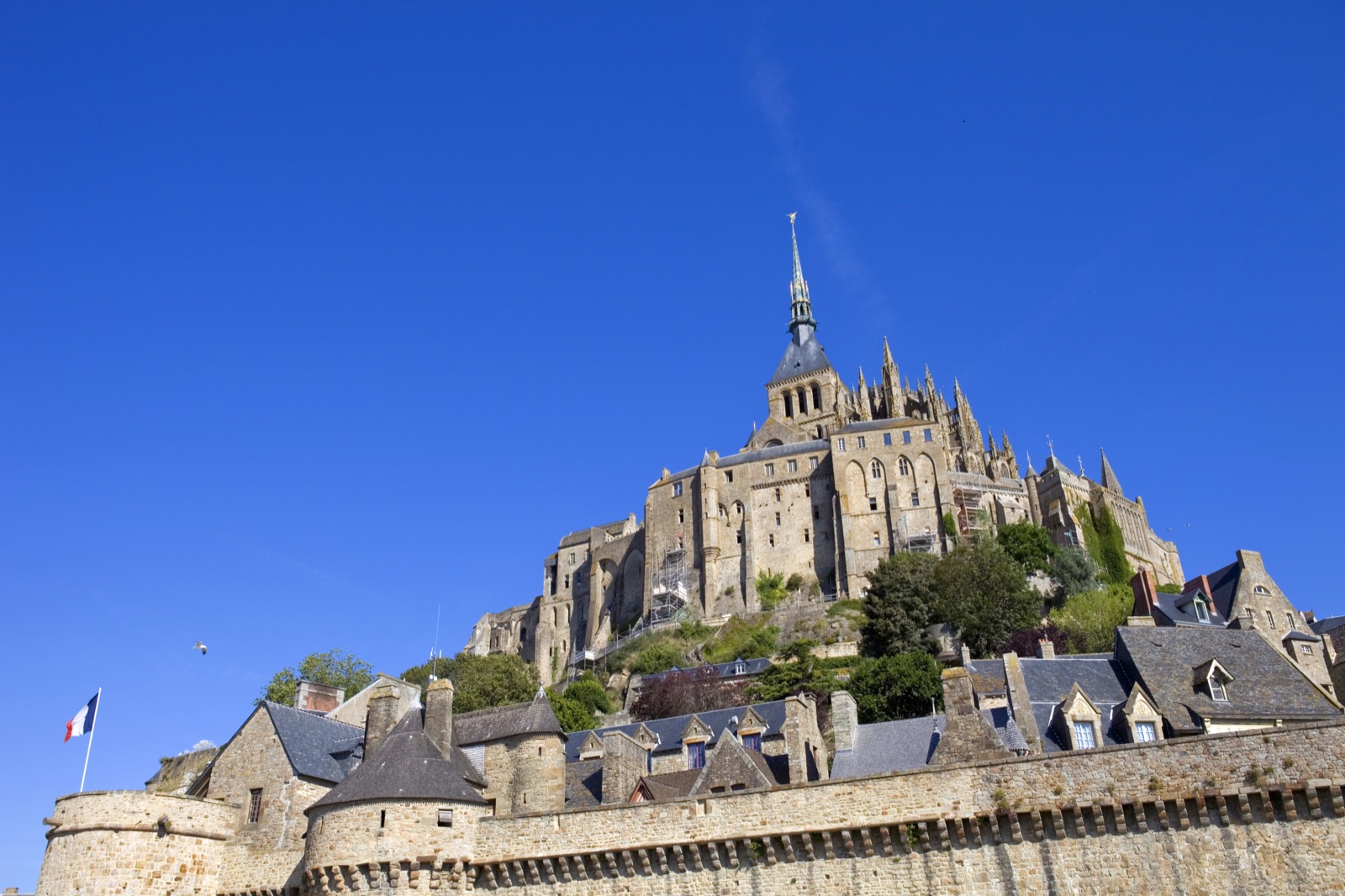
No, although it is easy to see why it looks like one. The building on the summit is an abbey, not a lord’s residence. What gives it the silhouette of a castle are the defences added around the village:
- Ramparts with seven towers, linked by a walkway that is open to the public. Since the Hundred Years’ War they have given the Mont its reputation as an impregnable fortress.
- Three successive gates guarding the Grande Rue, the village’s main street.
- The Gabriel Tower, a machicolated tower built around 1524 to protect the west side, later used as a mill and then as a lighthouse.
- A fortified abbey entrance, which became a guard room when a garrison was stationed there during the war.
So “castle” is the wrong word, but “fortress” is not: for more than a century the Mont was both a monastery and a military position.
From abbey to prison: the Bastille of the Seas
From the seventeenth century, as pilgrimage declined, the monks had to accept prisoners held under royal orders, and the abbey was gradually transformed into a prison. It was nicknamed the Bastille of the Seas. At the Revolution the State nationalised the property of the clergy and the monks were expelled; UNESCO notes that the abbey was abolished in 1789 and served as a prison until 1863.
In the nineteenth century it became a “central house”, a large state prison, and most of its rooms were refitted to hold as many common-law and political prisoners as possible. Its best-known inmates included Armand Barbès and Auguste Blanqui, opponents of the July Monarchy. The tourist office counts 14,000 prisoners passing through before 1863, with the tides and quicksand making escape impossible. While the abbey was a prison, more than a thousand people lived on the rock, against about 400 inhabitants in the Middle Ages.
One relic of that period is still on the visit: the great wheel in the monks’ former ossuary, installed in 1818 to hoist food up to the prisoners. Victor Hugo saw the prison too. In a letter to the poet Louise Bertin, written on 27 June 1836 from Mont-Saint-Michel, he set the open bay against “the pale figure of a prisoner” at a barred window.
The abbey’s managers make a point worth keeping: the prison years, although dark, helped save the abbey from complete destruction.
Restoration and the first tourists
In 1863, after appeals from Romantic writers and artists, the prison was closed. It left the abbey totally dilapidated. Protection followed: the Centre des monuments nationaux gives 1874 as the year the abbey was classified as a Historic Monument, while UNESCO’s page says the abbey, its ramparts and dependencies have been listed since 1862. Restoration work began, and the area around the Mont was developed to receive the first tourists in its history.
UNESCO credits the restorations of this period, notably the spire of 1897, with giving the buildings back their emblematic look. The neo-Gothic spire over the abbey church was erected in 1897 and topped by a gilded copper statue of Saint Michael by the sculptor Emmanuel Frémiet, made at the request of the architect Victor Petitgrand. The statue was restored in 1987 and regilded in 2016. Earlier repairs had already changed the church’s west end: the first three bays of the nave were destroyed after an eighteenth-century fire, and the classical façade you see from the west terrace was rebuilt in 1784.
The village found a new trade as well. In 1873 Annette and Victor Poulard opened an inn and served a wood-fired soufflé omelette to pilgrims at the end of their walk; in 1888 they moved to the premises where omelettes are still made today.
Causeway, tram and the Belle Époque
To carry the growing number of visitors, a road causeway was built in 1879. It solved the access problem and created a new one: the Mont lost its island character. UNESCO is blunt about the cause, naming the natural silting of the bay and especially the 1879 causeway.
Between 1901 and 1938 a steam tramway ran from Pontorson to the Mount. In the village, new buildings in Norman and Gothic Revival styles had replaced decaying old houses; between 1928 and 1938 most of these architectural pastiches were demolished to restore the village’s historic character.
War, monks and World Heritage
The Mont was spared during the Second World War, though it was occupied by the Germans between 1940 and 1944.
Religious life returned with the millennium of the abbey’s foundation. The Centre des monuments nationaux says a small community of Benedictine monks moved into the abbey in 1969, after the monastic millennium celebrations of 1965–1966; the tourist office dates the millennium and the return of a religious community to 1966. In 2001 the Benedictines were replaced by the Monastic Fraternities of Jerusalem, and today about a dozen monks and nuns live in the monument.
In 1979 UNESCO inscribed Mont-Saint-Michel and its Bay on the World Heritage List, one of the first French cultural sites to be listed. It was later listed again, as part of the Routes of Santiago de Compostela in France.
Making the Mont an island again
By the late twentieth century the bay was silting up fast around the causeway. The state body that now manages the site says that without intervention the Mont would have been joined to the mainland for good within forty years. In 1995 the project to restore its maritime character was launched.
The main pieces were built over two decades:
- The Couesnon dam, built from 2006 to 2009 and in service from 18 May 2009, replaced a first dam of 1969. It stores water at high tide and releases it on the ebb to flush sediment away from the rock.
- The bridge-walkway, inaugurated in 2014, replaced the old road causeway so that currents can flow freely round the Mont. The bridge section is 756 metres long.
- New car parks on the mainland and a shuttle service to the foot of the Mount.
UNESCO records that the Mont’s maritime character was re-established when the State’s major works were completed in 2015. The project represented an investment of €184.7 million. On the biggest tides, water again surrounds the rock for a short time; our guide to tides and bay walks explains when that happens and how to watch it safely.
Who lives on Mont-Saint-Michel today?
People still live here, but very few. Mont-Saint-Michel is a real commune, with its own town hall, elected council, parish church and cemetery. INSEE’s census counted 23 residents in 2023, down from 30 in 2017 and 41 in 2012; its long series starts at 105 in 1968. The tourist office puts it more warmly: a little under twenty Montois in all, plus a small community of cats.
Add to that the monastic community of about a dozen brothers and sisters in the abbey, and the contrast with the crowds is stark. The tourist office says the Mount welcomes nearly 2.5 million visitors and pilgrims a year; UNESCO’s page speaks of three million. Either way, visitors outnumber residents by more than a hundred thousand to one.
Where to see each chapter on a visit
Much of this history can be read in the stones if you know where to look:
- The pre-Romanesque church, Notre-Dame-sous-Terre, below the nave: the oldest surviving part of the abbey.
- The Saint-Martin crypt, one of the supports that hold the church on the summit.
- The Romanesque nave and the Flamboyant choir, side by side in the abbey church, a record of the collapse of 1421.
- The Merveille and its cloister, the thirteenth-century monastery.
- The prison wheel, installed in 1818.
- The ramparts, the Gabriel Tower and the three gates of the Grande Rue.
- The gilded statue of Saint Michael, high on the spire since 1897.
The village is free to enter at any time; the abbey needs a ticket, and there are about 350 steps from the foot of the Grande Rue to the top. Our guide to visiting the abbey covers tickets, opening hours and how long to allow, and our guide to getting to Mont-Saint-Michel covers the car parks and the shuttle. If you want the Cornish echo of this story, our comparison of St Michael’s Mount and Mont-Saint-Michel explains how a priory in Cornwall came to belong to this abbey.
Frequently asked questions
When was Mont-Saint-Michel built?
Building took centuries. The legend dates the first sanctuary to 708, Benedictine monks arrived in 966, the Romanesque abbey church was begun in 1023 and the Gothic Merveille from 1204. UNESCO describes the abbey as built between the eleventh and sixteenth centuries, and the spire was added in 1897.
Is Mont-Saint-Michel a castle?
No. It is an abbey with a fortified village around it. The ramparts, towers and gates were built for war, chiefly during the Hundred Years’ War, which is why it looks like a castle from a distance.
Do people still live on Mont-Saint-Michel?
Yes, a few. INSEE counted 23 residents in the commune in 2023, and the tourist office speaks of a little under twenty Montois. About a dozen monks and nuns of the Monastic Fraternities of Jerusalem also live in the abbey.
Was Mont-Saint-Michel ever taken by the English?
No. The English besieged it from 1423, but the Mount came out victorious in 1434 and became a symbol of French resistance. The nearby islet of Tombelaine did fall into English hands and served as their stronghold.
Was Mont-Saint-Michel really a prison?
Yes. Prisoners arrived from the seventeenth century, and after the Revolution the abbey was a state prison until 1863. The tourist office counts 14,000 prisoners in that period, and the hoisting wheel installed for them in 1818 is still on the visit.