Visiting Mont-Saint-Michel Abbey: Tickets, Hours and What to See
Mont-Saint-Michel itself is free. The village is a commune, open day and night, with no gate and no ticket; you can walk up the Grande Rue and around the ramparts without paying anything. The one thing you pay for on the rock is the abbey at the top, run by the Centre des monuments nationaux (CMN).
An individual abbey ticket costs €16 from 1 April to 30 September 2026 and €13 from 1 October 2026 to 31 March 2027. From 1 May to 31 August the abbey is open from 9am to 7pm; from 1 September to 30 April, from 9:30am to 6pm, with last entry 1 hour before closing. A self-guided visit takes between 45 minutes and an hour and a half, but the climb to reach the door adds a good deal more, so plan on half a day for the abbey and the village together. This guide covers tickets, the ways to visit, the route inside and the practical rules that catch people out.
Tickets and prices
The abbey ticket gives access to all the rooms of the abbey, including temporary exhibitions. Prices for an individual visitor:
| Ticket | 1 April–30 September 2026 | 1 October 2026–31 March 2027 |
|---|---|---|
| Individual ticket | €16 | €13 |
| Holder of a Nomad Paris–Mont-Saint-Michel train ticket | €13 | €11.50 |
| Individual lecture visit | €24 | €20.50 |
The Revelacio augmented-reality tablet costs €6 per device on top of any ticket.
Who gets in free
Free entry is generous, so check before you pay:
- Under-18s visiting with their family (not school groups).
- 18–25-year-olds who are citizens of EU countries or regular non-European residents in France (not in groups).
- Holders of the French disability mobility card and one companion, and jobseekers with proof.
- Everyone on the first Sunday of January, February, March, November and December, and during the European Heritage Days.
Minors must be accompanied by an adult to enter and visit the abbey.
The train-ticket discount
If you came on the Nomad train from Paris, keep your ticket. On showing it within 5 days of the trip, you pay €13 from 1 April to 30 September 2026, and €11.50 from 1 October 2026 to 31 March 2027. Our guide to getting to Mont-Saint-Michel explains the train routes.
Opening hours and closures
| Period | Opening hours |
|---|---|
| 1 May–31 August | 9am to 7pm |
| 1 September–30 April | 9:30am to 6pm |
| Closed | 1 January, 1 May and 25 December |
Last entry is 1 hour before closing. In practice that means arriving at the abbey door by 6pm in summer and 5pm in winter at the latest — and you need time to climb up from the shuttle before that. Some outdoor areas may close in bad weather, so on a stormy day the terraces may be shut even when the abbey is open. Check the hours on the abbey’s own site before you go.
Booking ahead
Abbey tickets go on sale 1 month in advance, online and at the ticket office. Booking is not compulsory for individuals — there is a ticket office on site — but it saves queuing at the busiest times, and an e-ticket holder goes straight to the scanning point after the security check.
At the top of the climb, the entrance is organised into three lanes: one for booked groups, one priority lane for disabled visitors and people who already hold a ticket, and one for everyone else, who buy their tickets in the former chaplaincy just after security. Security gates are installed at the abbey entrance and bags are visually searched.
Ways to visit the abbey
There are several formats, and the right one depends on how much you want explained.
- Self-guided. Free visit documents are available in 13 languages, and a self-guided visit takes between 45 minutes and 1 hour 30 minutes. This suits most visitors.
- The commented tour. The commented tour by the monument’s staff lasts about 45 minutes, in French or English, at no extra charge. You can book it online or sign up on arrival, subject to availability.
- The Revelacio tablet. The Revelacio augmented-reality tablet costs €6 per device on top of the entrance fee; it offers a Discover tour (45 minutes), an Exploration tour (1 hour 30 minutes) and a children’s tour. You leave an identity document while you use it.
- The lecture tour. The classic lecture tour with a CMN guide is limited to 30 people, lasts 2 hours and includes rooms closed to the public. It costs €24 to 30 September 2026 and €20.50 from 1 October 2026.
- “In the sky of the archangel”. The lace staircase, the highest point open to visitors, is reached only on this lecture visit, which climbs among the pinnacles and buttresses of the choir. It is the one to choose if you have a head for heights.
Tours sold by outside companies sometimes include abbey entry with an audio guide or a guide of their own; the tours page shows which include the ticket.
The climb: from the shuttle to the abbey door
The abbey sits at the very top of the rock, and the walk up is part of the visit. There are about 350 steps to the top: about 200 to the top of the Grande Rue, then 150 inside the abbey, and the Fanils entrance halves the climb.
You have two ways up from the end of the footbridge:
- Through the village. Through the village’s double gateway it is approximately 400 m to the abbey. The Grande Rue has irregular cobbles, narrows and then climbs with a very steep slope (almost 20%) and many steps without handrails. It is the lively route, lined with shops and restaurants.
- Through Les Fanils. Through the Fanils entrance on the left it is approximately 520 m to the abbey, along a wider lane and the Chemin de Ronde, then a short staircase with a handrail. It is longer but gentler, and usually less crowded.
At the foot of the abbey, the last climb is the Grand Degré extérieur: around a hundred steps, with a landing called the Barbacane where you can rest.
Allow time for all this. Depending on the number of visitors, it takes about 45 minutes to 1 hour to walk from the car parks to the abbey entrance.
What you see inside: the route
The abbey is laid out vertically over three levels, so the visit is a descent: you enter at the bottom, climb to the top and then work your way down through the buildings. The main stops on the route:
- The Guard Room, the fortified entrance where pilgrims were once welcomed.
- The Grand Degré, the inner staircase between the church and the abbots’ lodgings, linked by suspended walkways.
- The West Terrace, the abbey church’s original forecourt, with the widest view of the bay.
- The abbey church, at the summit of the rock.
- The cloister and the refectory, at the top of the Merveille.
- The Guests’ Hall, the Gothic hall where kings and nobles were received.
- The crypts, built into the slope to hold up the church above.
- The Wheel Room, with its giant treadwheel.
- The monks’ gallery, part of the older Romanesque monastery.
- The almshouse and the former storeroom, where the visit ends; the storeroom is now the abbey’s bookshop and gift shop.
There are free toilets at the beginning and in the middle of the route.
The West Terrace and the view
For many visitors the West Terrace is the high point of the day. Seen from the West Terrace, the bay extends over nearly 500 km², from the Pointe du Grouin to Granville. In good weather you can see the Chausey Islands to the north, and closer in, the islet of Tombelaine. To the south you look down on the dam, the Couesnon and the bridge-walkway linking the Mont to the mainland.
The terrace has a story of its own. It covers the original forecourt and the first bays of the nave, destroyed after a fire, which is why the church’s west front is a classical façade rather than a medieval one. The granite used to build the abbey came from the Chausey Islands, the islands you see on the horizon.
The abbey church and the spire
The abbey church crowns the rock at 80 m and stands on a platform 80 m long, held up by four crypts. It is a building of two eras:
- The abbey church was begun in 1023 on top of the rock, and its Romanesque nave still has its three-tier elevation and timber roof.
- The Romanesque chancel collapsed in 1421 and was rebuilt in Flamboyant Gothic after the Hundred Years’ War. The choir was completed in 1523, and the contrast between the plain nave and the soaring choir is easy to see.
Above it all, the neo-Gothic spire was erected in 1897 and is topped by a gilded copper statue of Saint Michael. The statue was restored in 1987 and regilded in 2016, which is why it catches the light so brightly.
The cloister and the Merveille
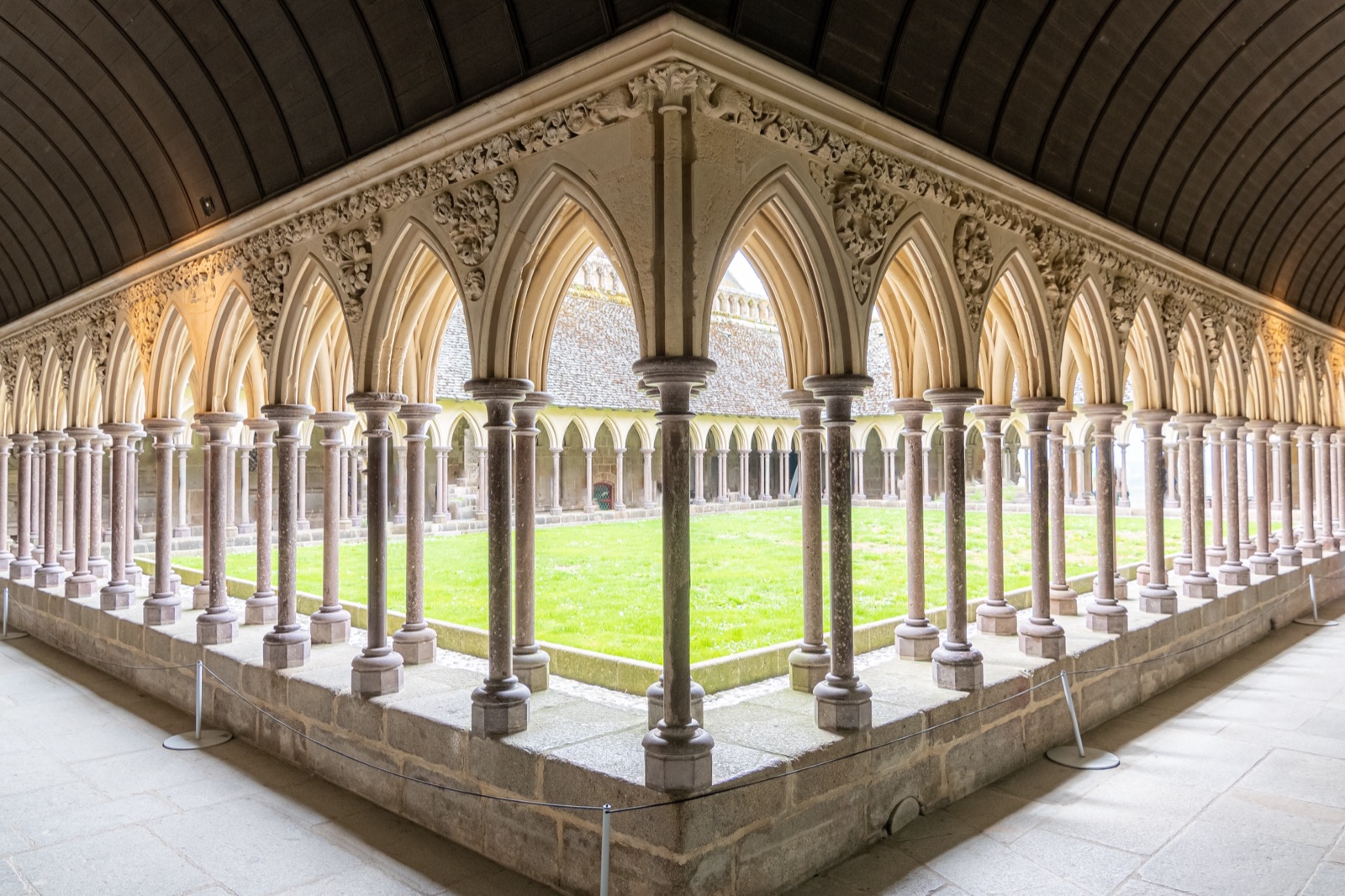
The Merveille is a group of Gothic buildings on the north side of the rock, on three levels, built in the thirteenth century. At the top is the cloister, a garden open to the sky and enclosed by a covered gallery.
The cloister’s colonnade is made of 137 columns arranged in staggered rows, which gives the shifting perspectives you notice as you walk round. One bay opens onto the sea: it was meant to lead to a chapter house that was never built. Next door, the refectory is filled with light from narrow windows you cannot see from the entrance.
Below the cloister, on the lower floors of the Merveille, are the Guests’ Hall and the great hall used as a scriptorium. Two hundred of the abbey’s medieval manuscripts are now kept in Avranches, across the bay.
The crypts and the prison years
The lower levels tell the abbey’s harder story. The Saint-Martin crypt has a vault spanning nine metres, one of the supports for the church above. Nearby, the great wheel was installed in 1818 to hoist food up to the prisoners when the abbey was a prison, a copy of the wheels used on medieval building sites.
The prison chapter lasted a long time. After the Revolution the monks were expelled, and until 1863, 14,000 prisoners passed through the abbey prison, the “Bastille of the Seas”. The prison closed for good in 1863, leaving the abbey dilapidated, and restoration began soon after. The CMN says the abbey was classified as a Historic Monument in 1874.
A short history in five dates
- 708: according to legend, the archangel Michael appears to Bishop Aubert in a dream and asks for a sanctuary on the rock.
- 966: Duke Richard I of Normandy installs Benedictine monks on the Mont.
- 1423–1434: the Mont withstands an English siege during the Hundred Years’ War.
- 1874: the restored abbey is classified as a Historic Monument.
- 1979: Mont-Saint-Michel and its Bay are inscribed on the UNESCO World Heritage List.
UNESCO describes the abbey, built between the eleventh and sixteenth centuries, as a technical and artistic tour de force, shaped by the difficult site it stands on.
The village: Grande Rue, ramparts and museums
The village is worth as much time as the abbey. It is a real commune with just under twenty residents, yet the Mont welcomes nearly 2.5 million visitors and pilgrims a year.
- The Grande Rue is protected by three successive gates: the Porte de l’Avancée, the Porte du Boulevard and the Porte du Roy. It climbs past shops, restaurants and the parish church of Saint-Pierre.
- The ramparts. Seven towers on the ramparts are linked by a walkway open to the public, which also leads up to the abbey. It is the quieter route on busy days, and the North Tower is a good place to watch the tide come in.
- The museums. The village has four museums, open daily from 10am to 5pm (last entrance), with the last ticket sale at 4pm. Museum entry is €9 for one museum or €18 for a pass to all 4, tickets on site only, and admission is free for children under 12. They cover the tides and boats, the Mont’s history, a medieval knight’s house and a multimedia show.
Mass and the monastic community
The abbey is still a place of prayer. Since 2001 the Monastic Fraternities of Jerusalem have lived at the abbey; about a dozen monks and nuns live there today.
- Mass at the abbey is celebrated Tuesday to Saturday at 12:15 and on Sunday at 11:30; arrive 15 minutes early at the Parvis de la Croix de Jérusalem, at the top of the Grande Rue.
- There are no services at the abbey on Sunday evening or on Monday.
- Services at the abbey are open to all, and anyone can attend Mass.
If you attend a service, dress and behave as you would in any church; the times can change, so check them with the community before you go.
How long to allow
- The abbey alone: 45 minutes to 1 hour 30 minutes inside, or 2 hours on a lecture tour.
- The climb: about 45 minutes to 1 hour from the car parks to the abbey door, depending on crowds.
- The village and ramparts: an hour or two at an easy pace, more with a museum.
- Half a day covers the abbey and the village comfortably; a full day lets you add a guided bay walk.
The tourist office suggests coming before 10am or after 5pm, when the Mont is far quieter, or in winter, especially January. An early start also means you reach the abbey door before the queue builds.
The abbey at night
In summer the abbey opens in the evening for the Nocturnes, a lit and sound-designed route through the buildings. In summer 2026 the Nocturnes ran from 3 July, open from 19:30 to midnight with last entry at 23:00, and tickets cost €21 full price and €18 reduced, with under-7s free. Check the dates for the coming summer on the abbey’s site.
Rules, accessibility and children
A few rules surprise visitors every day:
- Suitcases and large bags are not allowed in the abbey; bags smaller than cabin size are accepted, and the abbey does not accept any luggage for storage. Use the lockers at the Tourist Information Centre or inside the village gate.
- Pets are not allowed in the abbey, even in a carry-on bag (guide and assistance dogs are).
- Smoking and eating are not permitted in the abbey, and knives and scooters are not allowed.
Because of its position at the top of the rock and its many steps, the abbey is difficult to access for people with reduced mobility and pushchairs. The village and the abbey have no ramps or lifts. There are benches along the route, and visitors with a disability enter free with a companion on showing proof. Folded pushchairs are allowed inside, but a baby carrier is far easier.
Frequently asked questions
How much is the ticket for Mont-Saint-Michel Abbey?
An individual ticket costs €16 from 1 April to 30 September 2026 and €13 from 1 October 2026 to 31 March 2027. Under-18s with their family and EU citizens or residents aged 18 to 25 go free.
Do I need to book the abbey in advance?
It is not compulsory; there is a ticket office on site. Tickets go on sale 1 month in advance, and booking saves time at the busiest periods. Check the hours before you go.
What are the abbey’s opening hours?
From 1 May to 31 August, 9am to 7pm; from 1 September to 30 April, 9:30am to 6pm. Last entry is 1 hour before closing, and the abbey is closed on 1 January, 1 May and 25 December.
How many steps are there at Mont-Saint-Michel?
About 350: about 200 to the top of the Grande Rue and 150 inside the abbey. Entering by Les Fanils halves the climb.
Is the village of Mont-Saint-Michel free?
Yes. The village is a commune, freely accessible day and night without a ticket. Only the abbey and the car parks are charged.
How long do you need at Mont-Saint-Michel?
Half a day covers the climb, the abbey and the village. A self-guided abbey visit takes between 45 minutes and 1 hour 30 minutes, and the walk from the car parks to the abbey door takes about 45 minutes to 1 hour.