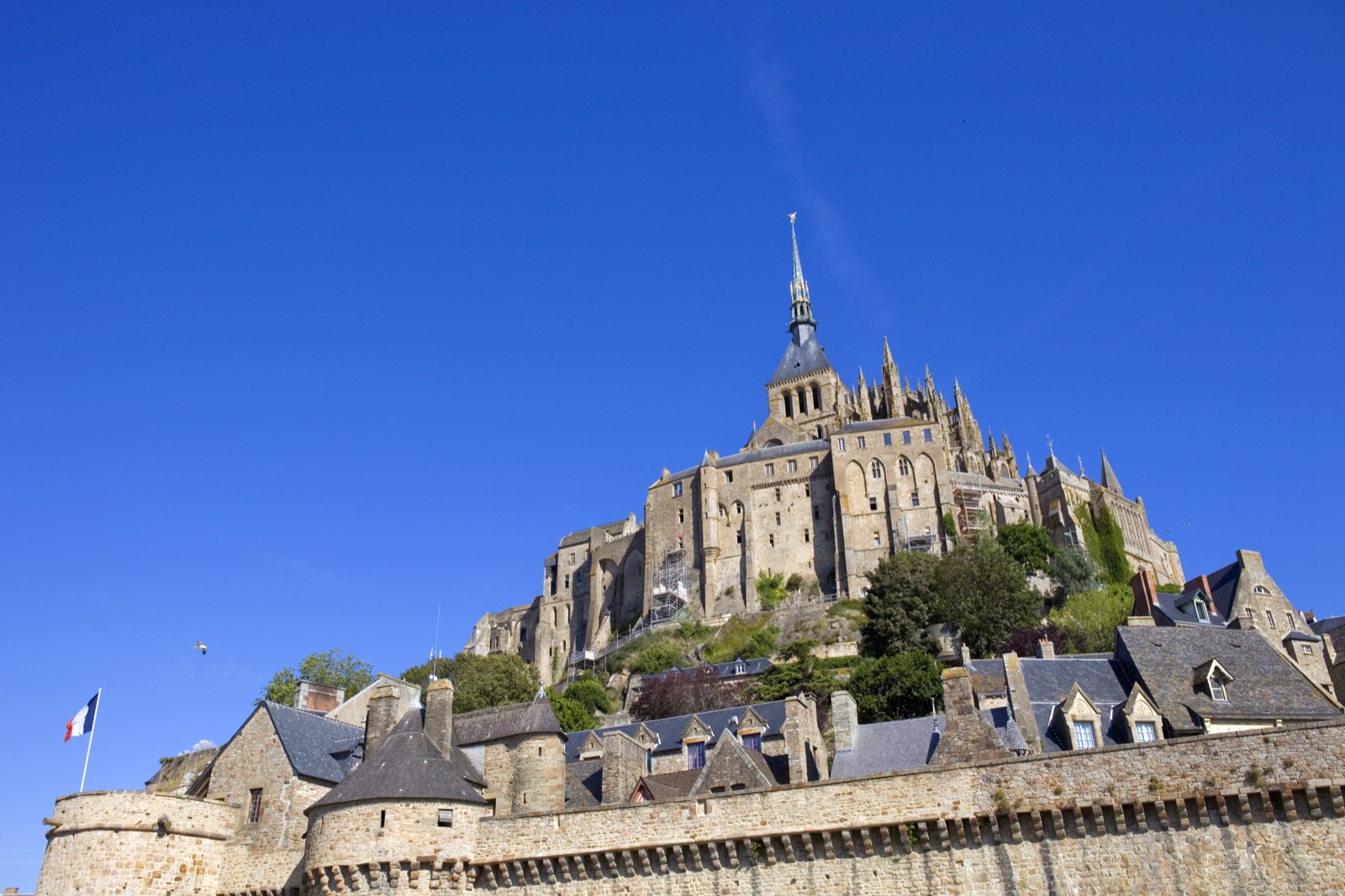
Inside Mont-Saint-Michel: The Village, Grande Rue, Ramparts and What to See
Everything inside the walls of Mont-Saint-Michel except the abbey is free. The village is a commune, open day and night with no ticket, and there are no opening hours for the rock itself, only for the shuttles and the abbey. The abbey at the summit is the one ticketed sight, and it has a guide of its own: visiting Mont-Saint-Michel Abbey covers tickets, hours and the route through its halls. This guide covers the rest of the rock.
There is a lot in a small space: three gates, one main street, a parish church, ramparts with seven towers, four museums, and lanes and gardens a few steps from the crowds. It is also steep and busy at midday. What follows takes you through it in the order you meet it, then covers timing and practicalities.
The village at a glance
| Sight | Where | What you need |
|---|---|---|
| The three gates | The main entrance | Nothing: free |
| The Grande Rue | From the Porte du Roy up to the abbey | Nothing: free |
| Saint-Pierre parish church | Towards the top of the village | Quiet during services |
| The ramparts walk | Through the drawbridge passage, on the right | Nothing: free |
| Les Fanils | The left-hand entrance | Nothing: free |
| Four museums | Grande Rue and the foot of the abbey | €9 each, or €18 for all 4 |
| The abbey | The summit | A ticket |
The way in and the three gates
The Passeur shuttle stops 350 m from the ramparts; our guide to getting to Mont-Saint-Michel covers the car parks and the ride. At the walls you have two ways in. In front of you is the main gateway, approximately 400 m from the abbey by the Grande Rue. On your left is Les Fanils, approximately 520 m from the abbey by a gentler route, described below.
Through the main gateway, the Grande Rue is protected by three successive gates:
- The Porte de l’Avancée. The first gate, built for carts as well as people, opens onto a courtyard of the same name. In it stands the former Corps de Garde des Bourgeois, a sixteenth-century guardhouse. The courtyard is also where the locker service and the paying toilets are.
- The Porte du Boulevard. The second gate, a few steps on.
- The Porte du Roy. The drawbridge gate, with the town hall in the Logis du Roy above it. The Grande Rue begins here, and on the right the drawbridge passage also leads to the rampart path.
Remember that turning. If the street ahead is packed, go right at the Porte du Roy and climb by the ramparts instead.
The Grande Rue
The Grande Rue is the village’s main street and the main route to the abbey. It has kept its medieval shops and signs, and the trade is as old as the pilgrimage: the first pilgrims could buy lead badges stamped with a scallop shell or showing St Michael from stalls here. Just inside, on the left after the drawbridge, the village’s tourist office shares a building with the Post Office.
It is also steep. The street has irregular cobbles, narrows, then climbs with a very steep slope (almost 20%) and many steps without handrails. There are about 350 steps to the top of the Mont, about 200 of them by the top of the Grande Rue and 150 more inside the abbey.
The parish church, the Pilgrim’s House and the forecourt of the Croix de Jérusalem stand at the top of the village. That forecourt is the meeting point for Mass at the abbey, celebrated Tuesday to Saturday at 12:15 and on Sunday at 11:30; arrive 15 minutes early.
Saint-Pierre, the parish church
The parish church of Saint-Pierre is easy to walk past on the way up. It is small, built in the fifteenth and sixteenth centuries and dedicated to St Peter, patron saint of fishermen, and pilgrims pass through it symbolically before reaching the abbey.
- The statue of Joan of Arc at the entrance honours the archangel who, by tradition, guided her during the Hundred Years’ War.
- The cemetery next to the church holds the tomb of the Poulard couple, the innkeepers behind the Mont’s famous omelette.
- A living sanctuary. Since 1886 the parish church has been the place of devotion to St Michael, and services are held there regularly. It generally stays open in the evening for private prayer.
Keep your voice down during services. Dogs are not allowed inside, although they are accepted in the village.
The ramparts walk and its towers
Since the Hundred Years’ War the ramparts have given the Mont its reputation as an impregnable fortress, and today seven towers are linked by a walkway open to the public, which also leads up to the abbey. It is free and it is the quieter way up on busy days.
The towers and corners worth stopping at:
- The North Tower. It dates from the thirteenth century and is an excellent vantage point for the tidal bore. The tourist office also calls it the best place on the Mont to watch the sun rise over the bay.
- The Gabriel Tower. A machicolated tower built around 1524 to guard the west side, later a mill and then a lighthouse. A small door beside it gives onto the old quay, where mooring rings remain.
- The old quay. On the west side, the tourist office’s pick for sitting quietly at sunset, looking out to the flat, sandy Breton coast.
- The northern rampart. With the Gabriel Tower side and the abbey’s esplanade, it is where the tourist office says the evening view is best.
The ramparts are also where you watch a big tide arrive. The first waves reach the west side, the quay and the Gabriel Tower, then wash around the Fanils buildings, while on the east side the water skims the foot of the North Tower. Our guide to tides and bay walks explains which days that happens.
Les Fanils: the gentler way up
The left-hand entrance is the one to know if you are short of breath, pushing a buggy or tired of crowds. From the Fanils entrance a lane wider than the main street leads along the Chemin de Ronde to the abbey, first to a short staircase with a handrail, after which it narrows considerably.
The Mont’s public establishment puts numbers on the difference: the main street has slopes of up to 20% with no ramp, while the Chemin des Fanils is a less crowded alternative with a 13% slope and about 50 steps. It is the longer route, but the tourist office says entering by Les Fanils halves the climb.
It is also the cyclists’ entrance: a bike park limited to 70 spaces is at the Fanils entrance, with no security or lockers, so bring a lock. Many guided bay walks meet just outside the walls here.
The chapel of Saint-Aubert
Outside the walls, on a rocky outcrop at the north-west end of the Mont, stands the small chapel of Saint-Aubert. It is named after the bishop of Avranches to whom, according to legend, the archangel appeared in 708, asking for the first sanctuary on the rock. The Ministry of Culture’s heritage register lists it as a classified Historic Monument, protected by an order of 15 February 1908.
It is not part of the abbey visit, so treat it as a sight seen from outside. Reaching its rock means going down onto the shore below the ramparts: do it only at low tide and in calm weather, and go no further. Out on the sands, the tides and quicksand make walking without a certified guide extremely dangerous, even close to the Mont.
The museums
The tourist office lists four private museums in the village, with one set of rules:
- Open daily from 10am, with tickets on sale until 4pm and last entry at 5pm.
- €9 for one museum, or €18 for a pass to all 4; free for children under 12.
- Tickets on site only, with no advance booking.
The pass costs the same as two single tickets, so it pays only from the third museum. One caution: the Mère Poulard group, whose site lists the Logis Tiphaine, the Maritime Museum and the Historical Museum, shows only those three, so check that the Archéoscope is open, and what the pass covers, before you buy.
- The Maritime Museum, in the lower part of the Grande Rue, explains the tides of the bay and the works that restored the Mont’s maritime character. It has a collection of 250 antique model ships.
- The Archéoscope, opposite the parish church, is a multimedia show on the history of the Mont, told with videos, engravings and lighting effects.
- The Logis Tiphaine is a fourteenth-century house showing how a medieval knight lived, with period furniture, tapestries, the armour of Bertrand du Guesclin, Constable of France, and the astrology study of his wife, Tiphaine de Raguenel. According to legend, he had it built for her because the Mont was one of the safest strongholds in the kingdom.
- The Historical Museum, at the foot of the abbey, retraces 1,300 years of the Mont’s history with wax figures of the monk-builders and the prisoners, and reconstructs the dungeons of the Bastille of the Seas. In its garden, a nineteenth-century periscope, one of the last five in the world, looks out over the bay.
With time for only one, choose by interest: the Maritime Museum for the tides, the Logis Tiphaine for a medieval house, the Historical Museum for the prison years.
Quiet lanes, stairways and gardens
Most visitors see one street. The quiet corners are a few steps away.
- The Venelle du Guet. Nicknamed Cuckold’s Alley, it is the smallest street on the Mont, so narrow, the joke goes, that you could not pass through it wearing horns. Walk up the Grande Rue and turn left in front of the Hotel La Croix Blanche.
- The gardens. Half of the village has always been left free of buildings; during sieges the inhabitants grew food there. The houses along the Grande Rue hide small enclosed gardens, visible from the ramparts or from the alleyways and suspended staircases.
- The monks’ garden. At the foot of the abbey the monastic community still cultivates its vegetable garden.
- The wild side. The steeper north side of the rock has stayed wild, which is why the northern rampart feels so empty.
The easy way to find them is to go up by the Grande Rue and come down by the ramparts.
When the crowds peak and how to avoid them
The tourist office says the Mont welcomes nearly 2.5 million visitors and pilgrims a year; INSEE counted 23 residents in the commune in 2023. Most of those visitors arrive in the same few hours and share one street.
- Come early or late. The tourist office suggests coming before 10am or after 5pm, when the Mont is far quieter, or in winter, especially January.
- Climb by the ramparts or Les Fanils, which bypass the busiest stretch of the Grande Rue.
- Shop on the way out, when the street empties.
- Watch the abbey clock. Last entry is 1 hour before closing, so if you arrive late, go to the abbey first and see the village afterwards.
Evenings on the Mont
Most day visitors leave before dark. Every evening the Mont lights up at nightfall, and the tourist office says the connoisseur’s visit begins at the end of the afternoon and continues until sunset.
- The shuttle runs late. In July and August the Passeur runs from 7am to 1am, in mid season until 11pm and in low season until 10pm. The tourist office gives slightly earlier last departures: 12:45am in July and August, 10:45pm in mid season and 9:45pm in low season, so allow a margin.
- Parking is cheaper. From September to June parking is free from 6:30pm to 3am; in July and August an evening stay costs €15.
- The abbey opens at night in summer. In summer 2026 the Nocturnes ran from 3 July, from 7:30pm to midnight; the West Terrace, the cloister bays and the northern gardens are the places to watch the sunset.
- The services go on. Vespers are sung in the abbey church or, in winter, in one of its crypts.
To see the Mont after dark and again at dawn, stay the night: our guide to where to stay at Mont-Saint-Michel compares the hotels on the rock and nearby.
Food and drink
One dish dominates: the wood-fired soufflé omelette that Annette Poulard served to pilgrims. The tourist office dates the Poulards’ first inn to 1873 and their move to the present premises to 1888, where the omelette makers still demonstrate the original recipe day after day; the Auberge La Mère Poulard’s own history starts in 1888. Our article on La Mère Poulard’s omelette tells the story.
The bay supplies the rest: salt-meadow lamb, raised on grass the sea periodically covers; mussels and oysters; and salicornia, cider and other Norman drinks, which the abbey lists among the specialities of the bay. There are many restaurants at the foot of the abbey, in the village and around the Mont. Eating is not permitted inside the abbey, so eat before you climb or after you come down.
Toilets, lockers, money and dogs
- Toilets. The toilets in the entrance courtyard are paying, with a changing table; the public establishment puts the town hall’s toilets inside the walls at €1. Free toilets, open 24 hours a day and accessible, are on the right of the main street 50 metres after the drawbridge, and another free toilet is at the top of the main street next to the parish church. The abbey has free toilets at the beginning and in the middle of its route.
- Lockers. Suitcases and large bags are not allowed in the abbey. The 100 lockers by the shuttle departure point cost €2; the locker service in the Cour de l’Avancée is the one inside the walls, and the tourist office advises using the lockers by the shuttle first.
- Money. There is no foreign currency exchange on the Mont, but a cash machine on the front of the Post Office in the Grande Rue is accessible 24 hours a day.
- First aid. A first-aid station on the Grande Rue, opposite the Post Office, opens on busy days.
- Dogs. Dogs on a lead are accepted in the village but refused in the parish church and the abbey, except guide and assistance dogs. The kennel at the Tourist Information Centre has 5 places and costs €8.60 per day per animal.
Accessibility
The Mont’s public establishment is frank: the village remains hard to get around in a wheelchair because of its steep slopes, the crowds and its many stairs, and the village and the abbey have no ramps or lifts.
- The main street has slopes of up to 20% with no ramp; the Chemin des Fanils has a 13% slope and about 50 steps.
- The abbey is not wheelchair accessible: 54 steps lead to the ticket office, then 96 more.
- Getting there is easier. Car park P2 has 45 spaces for disabled visitors near the shuttles, the Passeur has mechanical ramps and two wheelchair spaces, and the wooden bridge-walkway can be used in a wheelchair, though it is slippery in rain.
- Help on site. Wheelchairs are lent free of charge at the Tourist Information Centre against an identity document.
For a visitor with limited mobility, the gates, the Avancée courtyard and the first stretch of the Grande Rue are realistic; the upper village and the abbey are not.
A route through the village
With an hour or two, this loop sees the main sights without repeating a stretch:
- Enter by the main gateway and pause in the Avancée courtyard by the old guardhouse.
- Walk up the Grande Rue past the Maritime Museum, looking for the Venelle du Guet on the left.
- Stop at Saint-Pierre and its cemetery, then continue to the top of the village and the abbey if you have a ticket.
- Come down by the ramparts: the North Tower, then along the walls to the Gabriel Tower and the old quay.
A guided village walk follows a similar line, up the Grande Rue and along the ramparts, with a licensed local guide and the option to add abbey entry.
Frequently asked questions
Is it free to walk around inside Mont-Saint-Michel?
Yes. The village is a commune, open day and night, with no ticket. The gates, the Grande Rue and the ramparts walk are free; only the abbey, the private museums and the car parks charge.
What is there to see inside Mont-Saint-Michel besides the abbey?
The three gates, the Grande Rue, the parish church of Saint-Pierre, the ramparts and their seven towers, the Gabriel Tower and the old quay, four museums, and quiet lanes such as the Venelle du Guet.
Can you walk on the ramparts?
Yes. Seven towers are linked by a walkway open to the public, which also leads up to the abbey. You reach it through the drawbridge passage on the right, just inside the Porte du Roy.
How much do the museums cost?
€9 for one museum or €18 for a pass to all 4, free for children under 12. They open daily from 10am, and tickets are sold on site only, until 4pm. Check before you go.
Are there toilets inside Mont-Saint-Michel?
Yes. There are paying toilets in the entrance courtyard, free toilets open 24 hours a day on the main street 50 metres after the drawbridge, and another free toilet next to the parish church.
Is Mont-Saint-Michel accessible in a wheelchair?
Only in part. The main street has slopes of up to 20% with no ramp, the Chemin des Fanils has a 13% slope and about 50 steps, and the abbey is not wheelchair accessible.